Yehoshua and Srebnitsky
City of GodThe relationship between Yehoshua and Srebnitsky is the emotional and moral core of the Kovno Ghetto passages in City of God, a bond forged not of blood but of survival, silence, and a shared performance of false kinship. The boy, a ten-year-old runner for the ghetto council, is given the identity of Yehoshua Mendelssohn—the name of the tailor's actual dead grandson—and delivered to the old man's door by a council woman whose palm is damp with fear. From the first moment, the arrangement is understood by both parties as a temporary fiction: Srebnitsky is a thin, ill-tempered, somewhat stooped man with gray hair curling from under his cap, narrow shoulders over which a shirt and vest hang loosely, a musty smell the boy thinks of as grandfather smell, and pale blue eyes that glimmer with water. The most powerful impression he makes on the boy is that he is a stranger.
The False Grandfather's Household
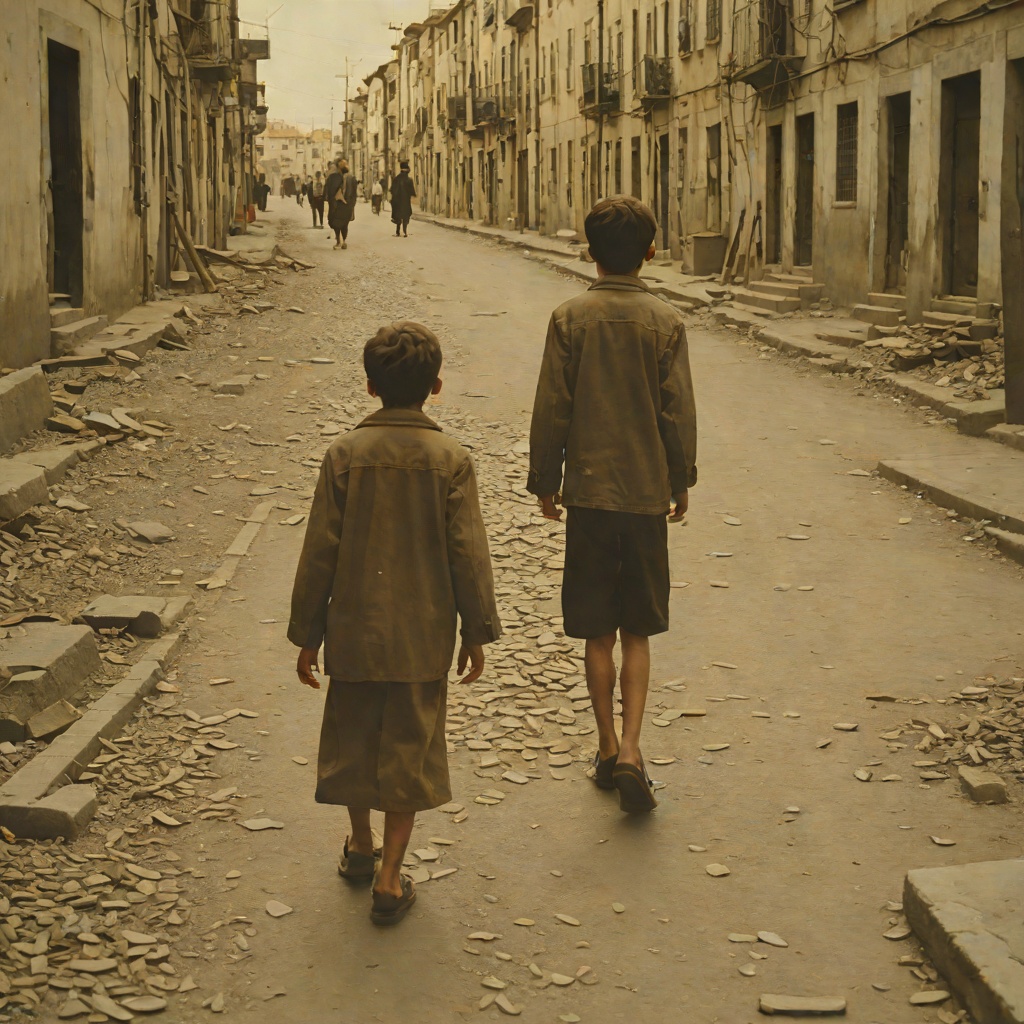
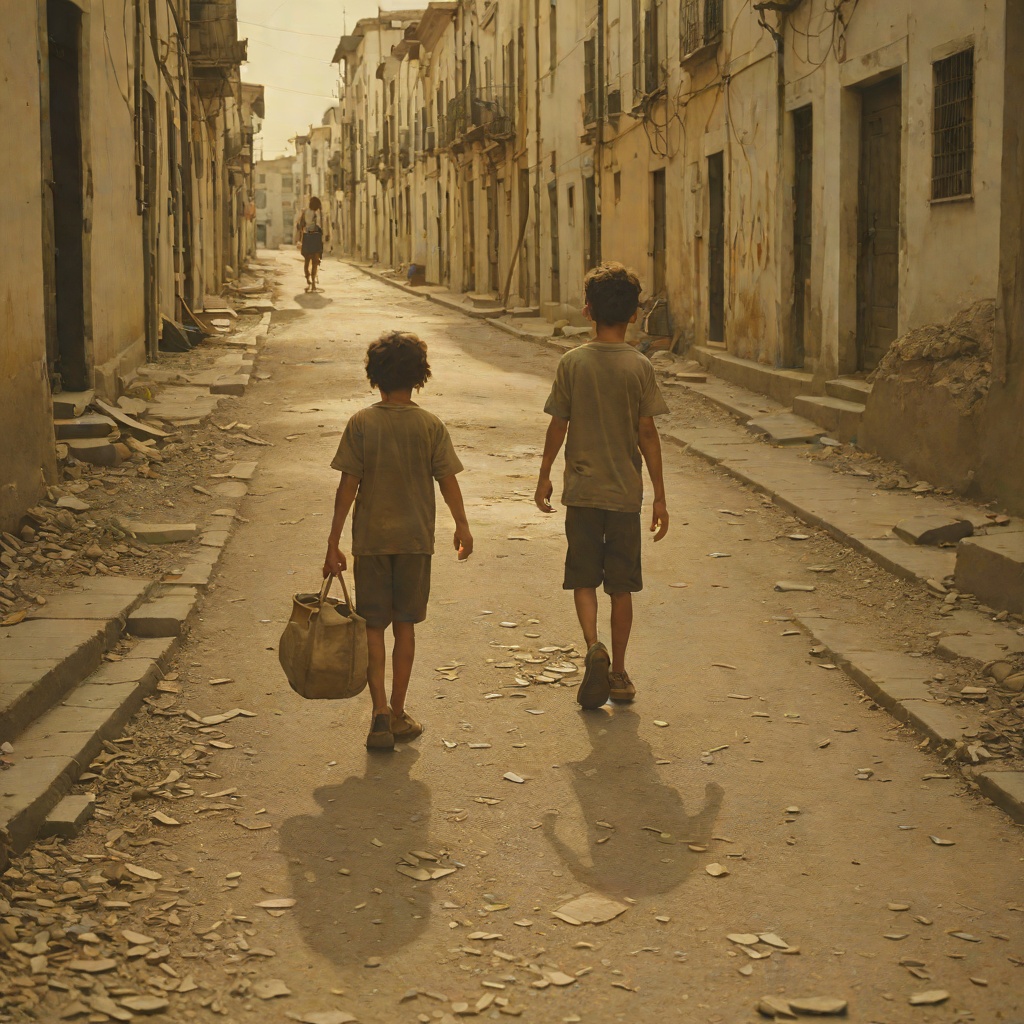
Srebnitsky's home consists of two rooms, a front and a back, and a small alcove that serves as a kitchen; the boy sleeps on a daybed in the front room, where the tailor maintains his business. The old man greets his new charge without smiling, speaking not to the boy but seemingly to the work in his hands—long, smooth, nimble hands that seem far younger than the rest of him, hands that fascinate the boy as the needle flies through cloth, producing perfectly straight lines of stitches with amazing speed. The household economy runs on barter and scrip rather than money, which the Germans cannot police very well: a carpenter whose jacket Srebnitsky mends fixes a shutter so it closes properly, a woman whose coat he lines leaves some soup. Nothing can be thrown out; every scrap of thread and rag goes back into the rag bin, from which the tailor reconstructs threadbare coats, dresses, and trousers so they can be worn again, at least for a little while. The old man treats the boy as an adult boarder who can take care of himself, letting out his clothes as he outgrows them, bartering for a pair of wooden shoes when the boy begins limping because his shoes have become too tight, cooking their potato soup or cutting their bread and pointing to the table where they eat in silence. The boy accepts all this as the best that can be, never coming to feel that the arrangement is anything but temporary.
The Tailor's Art and the Boy's Admiration
The boy's admiration for Srebnitsky's hands becomes the central thread of their life together. Living undercover, he can no longer see his friends, have his music lesson with Mrs. Levin, or see little Sarah, who was so crazy about him; the council woman who gave him his new name visits from time to time, bringing Srebnitsky a few cigarettes or schnapps in a small jar, which he accepts as his due, and a pocket comb for Yehoshua Mendelssohn. One day the boy returns from wandering to find Srebnitsky cutting patterns from a thick bolt of luxurious charcoal-colored material of remarkable pliancy, working with a concentration that demands silence, his lips moving as if he is talking to himself, seemingly angry. The boy sits to the side and watches the hands; eventually the tailor lifts the sections of cloth he has cut and tacked and slips them over a wire male, which in that instant becomes an S.S. officer in the process of realization. Srebnitsky reveals that his fame has reached S.S. Major Schmitz, the commandant and executive of all terror, who has commissioned the uniform; the boy, with a youth's directness, says, "You had to," and the tailor agrees, telling himself it is a hopeful sign, the first stirrings in their evolution that one of these thugs can actually be party to an ordinary business deal. Uncovering a sewing machine with a treadle, Srebnitsky argues with himself as if the boy were disputing him: "If not for his skills, Srebnitsky would not be here. Just remember that. These hands you're always looking at with admiration—for I know that about you, although you are too high-and-mighty to become a tailor yourself—it's these old hands of his that have kept him alive. And if you don't think that's worth a damn, they've kept you alive too, Yehoshua Mendelssohn!"
The Truth of the Dead Grandson
It is at this moment that the boy realizes the full truth: just as Srebnitsky is a stranger to him, he is not the tailor's grandson—he has been given the name of the tailor's dead grandson. The old man never tells him what happened; the boy learns it later at the council. Before there was a ghetto, when the war came to their city, the Russians pulled back to the east, and their Lithuanian neighbors took the opportunity to have themselves a pogrom. Srebnitsky lived with his daughter, son-in-law, and grandson Yehoshua in an apartment on Vytauto Street; while he was at work in his shop in another part of town, a mob broke down the door, rushed his family out into the street, and clubbed them to death. All around, others were doing the same, killing Jewish people and looting their houses of furniture, rugs, dishes, radios, everything. Srebnitsky ran home and found the bodies of his daughter, her husband, and his son on the sidewalk. When the Germans occupied the city, they restored order by evicting all Jews and resettling them in the ramshackle slum on the other side of the river that became the ghetto—not for their protection, but to save them for forced labor in the war factories. Srebnitsky, bereft of all his living relations, had made the trip alone. The boy remembers his own family's trek, his parents pushing a cart of belongings and furniture across the bridge, and hiding in their own apartment on a high floor with the bureau lodged against the front door.
The Defiance and the Hanging
One morning in the winter, just minutes after Srebnitsky has sewn the military insignia on the shoulders and the piping on the lapels, a black Mercedes sedan with a squarish cab, a long low-slung engine hood with a chrome radiator grille, huge silver headlights, and a driver in the enlisted man's S.S. uniform with a holstered pistol pulls up by the front door. The boy, who has been bothered by the enterprise from the beginning because it violates the rule to remain as anonymous as possible, runs into the back room and slips out the door, positioning himself by the vegetable garden fence some distance down the block, drawn not by the car's luster but by the heat rising from its engine. Major Schmitz comes out wearing his new custom-made uniform, including a rakishly blocked garrison cap; he is a portly man with wide hips. Behind him is Srebnitsky, carrying the old uniform over his arm. The driver springs forward to take it, opens the rear door for his commandant, and settles the uniform carefully over the front seat. Schmitz stands posing in his smart uniform and black boots with his hands on his hips and a contemptuous smile, and the two of them joke about payment—"Not one pfennig for Srebnitsky's beautiful work, even the sleeves lined, and all of it done in double stitching?"—laughing heartily at the joke of a Jew expecting to be paid. Then Srebnitsky suddenly frowns, his shoulders rounding as he peers closely at something on the new uniform, his scissors in his hand. "Forgive me, Your Excellency, a bit of thread, one moment," he says, and putting his hand to the chest of the commandant, who looks skyward to endure this final snip of perfection, he yanks at the lapel and slashes the scissors-point downward across the front—a gesture so sudden that from one moment to the next a big flap of the ruined tunic hangs down to the officer's knee. "Sew it yourself then, thief!" the tailor shrieks. "Thief, that's what you are, that's all you are. All of you, thieves, thieves of our work, thieves of our lives!"
The major stands dumbfounded, having even cried out in fear, but his driver leaps upon the old man and clubs him to the ground with the butt of his pistol, then begins kicking him, shouting, "You dare to attack a German officer? You dare to lift your hand!" He aims his pistol at the stricken tailor and would have shot him then and there had the major not commanded him to stop. Holding his ripped tunic against his chest like a woman covering her breasts, Schmitz looks around to see who has witnessed his humiliation; the boy, who has turned his back and is disappearing into the alley between two houses, is not seen. From the shadows he watches the car flash by, then runs back to Srebnitsky, who lies in the snow where he has fallen, his head bleeding, coughing and poking at his throat and trying to speak. The old man makes an attempt to smile, then coughs and cackles, his eyes rolling up in his head, until a neighbor pulls the boy to his feet: "Don't you know any better? He's finished, your old man. Move, run, get out of here!" The neighbor means that when a head of family commits a crime or is otherwise designated for execution, it is German policy to kill his dependents as well—which is why, when his own parents had not come home, the boy was quickly taken to the council office and given another name.
The boy runs to the council by himself; his arrival stills everyone in the busy place, the pale terrified face of a child a warning signal they know all too well. Several boys are summoned and dispatched to spread the word among the houses and shops for people not known to the Germans to go into hiding, and in a matter of minutes everyone in the ghetto knows what the tailor has done. News comes back that he has been apprehended and taken to Gestapo headquarters; rumors are rife that the price for his act will be thirty, fifty, a hundred Jewish dead. The council president, Dr. Sigmund Koenig, a handsome man in his sixties, a man of great dignity, a good six feet tall, eventually goes outside in his gray double-breasted suit with a clean shirt and tie, wearing no coat or hat, and his mere appearance stills the crowd; he tells them he is awaiting a call from the ghetto commandant but doubts there is any immediate danger of a major action, speaking almost in a whisper. The boy, standing behind him in the doorway, can barely hear what he says.
The Runner and the Aftermath
The boy is quickly put on official runner business to keep him from brooding, accompanying Micah, an older gangly boy, on his rounds that evening as Micah informs his "customers" that they must be at the square at dawn. After a while Micah encourages the boy to deliver the message himself; he manages all right, going around telling everyone to be there to watch the old man hang. He feels weird, as dizzy as if he had been turned around in circles—no longer the tailor's pretend grandson but a pretend someone else, a nameless public charge, a council runner, a boy who knows how to hide when a person is in trouble and how to tell everyone to come see the trouble the person is in. He spends his first night upstairs in the runners' dormitory above the council offices in the grip of a cold dread, sickened by the memory of the old man knocked down and kicked, lying in the snow with his eyes rolled up in his head, thinking that he should have helped him instead of running away, that he could have stayed with him for a little while anyway, even if only to get him back to his house. He does not exonerate himself because he was a child. He also thinks of what he has seen in the council office, disturbed not by the kindness he was treated with but by the uniform calmness of being on the inside, of seeing the whole picture—a calmness that, to his young eyes, proposes that what is happening is routine, as if the terrible power of the Germans over them were normal.
At dawn the boy watches the hanging. Srebnitsky is dragged to the platform, unable to walk, his legs appearing broken; his hands—those slender deft instruments the boy had admired—are mangled protuberances covered with dried blood. The policemen lift him up the steps, hold him propped under the arms while another ties his hands behind him and slips the noose over his head. At the last moment before they kick away the stand under his feet, the tailor seems to come out of his agonized stupor, lifts his head, and—of this the boy is sure—sees the scene before him clearly and, appreciating its magnitude, reads his glory into it; a mad triumphant light flashes from his eyes before the stand is kicked from under him and his frail body swings from the neck. There is no movement, no struggle; the life is gone from him almost instantly. The officials drive off, the soldiers disperse, the work details gather in their ranks and pass through the gate and begin their trek across the bridge, and an S.S. man hangs a crudely lettered sign around the corpse's neck: "This Jew dared to raise his hand against a German officer." The boy lingers in the square, sitting down for a while with his back against the platform, having wanted Mr. Srebnitsky to see him, to see that he hadn't forgotten him. He had thought for a moment that the tailor had stabbed the commandant, so great was his rage, but he has since concluded that Srebnitsky must have understood the disaster that would befall the ghetto were he to kill the man—that what he accomplished was specifically self-sacrificial, a modulated act of defiance as deft and precise as his tailoring. Yet what lingers in the boy's mind after all these years of this cantankerous old man, this iconoclast, this embittered soul, is that he let out his clothes as he outgrew them and saw to it that he got a new pair of shoes when the old ones no longer fit. The Germans order the body left hanging on public display for twenty-four hours, an impiety an Orthodox rabbi finds intolerable.
The Relationship's Legacy
The relationship between Yehoshua and Srebnitsky reverberates far beyond the ghetto. Years later, when the boy—now the adult narrator—considers the act that brought about the tailor's death, he concludes that while anyone could be driven to the point of forswearing life, in cases like Srebnitsky's it was not the simple desire to die but the desire for self-transcendence which once realized brings one to the end of life; that is something different, not the same thing at all. The ordinary unendurable torments they all experienced were indeed exceptional in the way they were absorbed in each heart. The boy's own survival is bound up with the tailor's: the false identity of Yehoshua Mendelssohn, the name of the dead grandson, is what saves him, and the council woman's visits, the cigarettes and schnapps, the pocket comb, are the small currency of that protection. The boy's testimony, told to his daughter Sarah, becomes part of the family's inherited memory; Sarah, reading the recovered ghetto archive decades later, finds a photograph of seven little boys in front of a wood cabin, standing at their idea of attention on the steps, wearing military-school caps and stars on their breasts that might possibly be imagined as insignia of their office as runners for the council—unsmiling little boys, underdressed, with short pants and sweaters and jackets they have outgrown, each of them at attention, feet together, arms pressed against his sides, looking into the camera in the full knowledge of death. Sarah finds her father in the first row. The tailor's hands, which kept them both alive, and the scissors that ended his life, remain the emblem of a defiance that was at once an act of love and an act of war.